

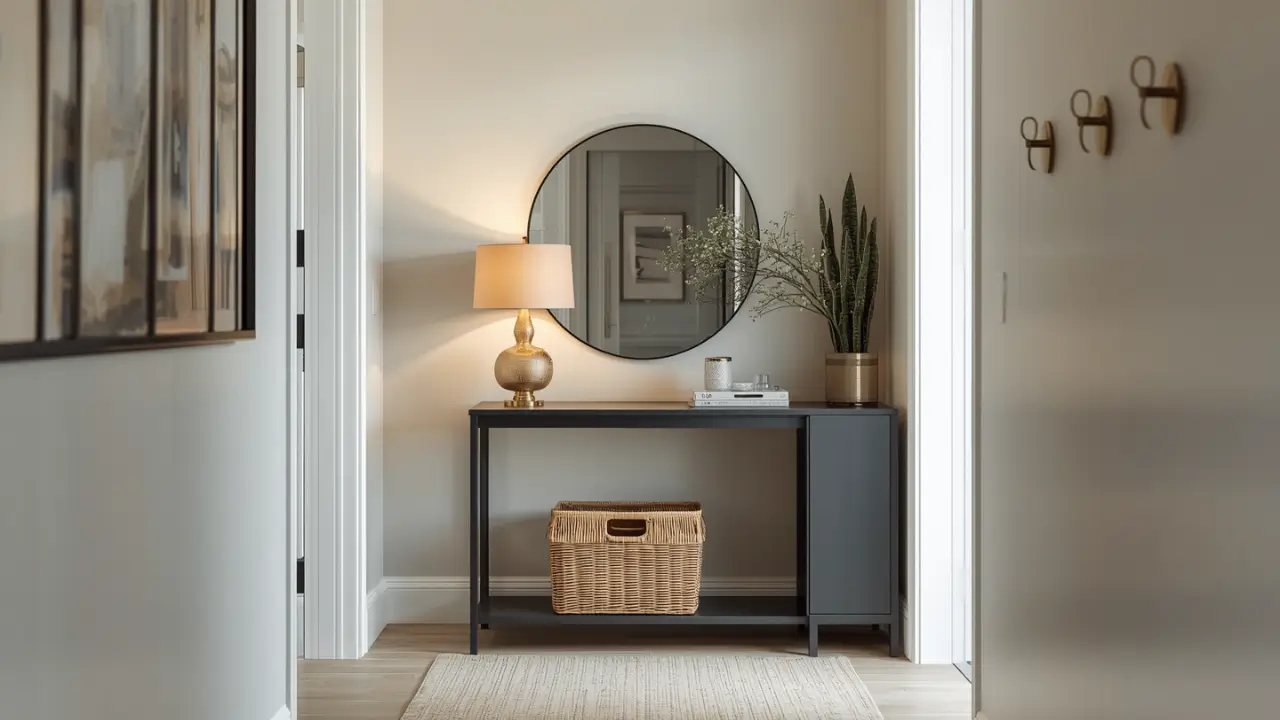
Small entryway ideas can make a surprising difference in how your home feels every single day.
The entryway is the first thing you see when you come home and the last place you pass before leaving. Even when it is tiny, narrow, awkward, or almost nonexistent, it has a big impact on your routine.
A cluttered entryway can make the whole home feel rushed. Shoes pile up. Bags land on the floor. Keys disappear. Coats hang over chairs. Mail gathers in random places. And suddenly, the first impression of your home feels more stressful than welcoming.
But a small entryway does not need to be perfect or large to work well.
With the right choices, even a compact corner near the door can become organized, beautiful, and practical. The goal is not to decorate every inch. The goal is to create a smart transition space between the outside world and the life you want to feel at home.
This article shares 10 small entryway ideas to help you add storage, style, and calm to one of the most important spaces in your home.
Why a Small Entryway Matters
A small entryway matters because it shapes the rhythm of your home.
It is where you drop what you carry. It is where you look for keys. It is where shoes, bags, umbrellas, jackets, packages, mail, dog leashes, sunglasses, and daily essentials often end up.
When this area has no system, clutter spreads quickly.
A well-planned entryway can help you:
- leave the house faster;
- find everyday items easily;
- reduce visual clutter;
- keep floors clearer;
- protect the rest of the home from mess;
- create a warmer first impression;
- make a small home feel more intentional.
This is especially important in apartments, small houses, narrow hallways, and open layouts where the front door leads directly into the living room.
A small entryway should answer three simple questions:
Where do things land?
Where do shoes go?
What do I need before leaving?
Once you answer those questions, the design becomes easier.
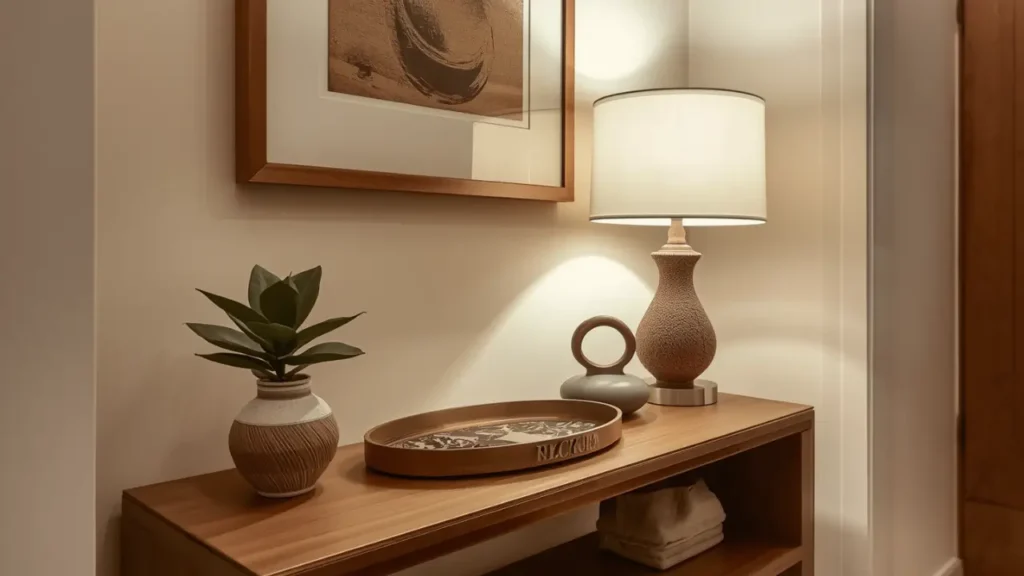
1. Start With a Narrow Console Table
A narrow console table is one of the most useful small entryway ideas because it creates a landing zone without taking up too much space.
This is where you can place keys, sunglasses, mail, a small tray, a lamp, or a decorative bowl. It gives daily objects a place to go, which helps prevent clutter from spreading across the kitchen counter, dining table, or sofa.
For small spaces, look for a console table that is:
- narrow in depth;
- visually light;
- proportional to the wall;
- easy to walk around;
- simple enough not to overwhelm the space.
A table with drawers can be helpful if you want to hide small items. A console with an open shelf below can hold baskets for shoes, scarves, or bags. A very slim table can work even in a hallway if there is enough clearance for movement.
If your entryway is extremely small, a floating shelf can do the same job with less visual weight.
The key is not to create a display area for too many decorations. Keep it practical and edited.
A small tray, one lamp, a plant, and a bowl may be enough.
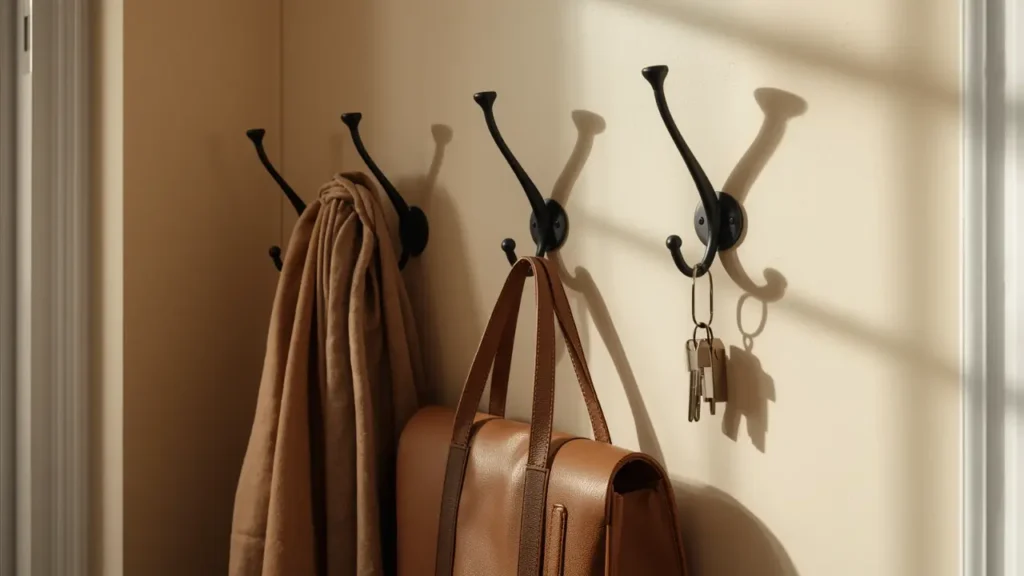
2. Use Wall Hooks Instead of a Bulky Coat Rack
Wall hooks are a simple solution for small entryway organization.
Unlike freestanding coat racks, hooks do not take up floor space. They can be installed behind a door, along a narrow wall, near a hallway, or above a bench.
Hooks are useful for:
- coats;
- bags;
- hats;
- scarves;
- dog leashes;
- umbrellas;
- reusable shopping bags;
- children’s backpacks.
The secret is not to install too many or overload them. Too many hanging items can make the entryway look messy even when everything technically has a place.
Choose hooks that match the style of your home. Matte black hooks can feel modern. Brass hooks can feel warm and elegant. Wood hooks can feel natural and relaxed. Simple white hooks can disappear into the wall for a cleaner look.
For a more polished entryway, install hooks in a straight line and keep spacing even. If the space feels too plain, add a small framed print or mirror nearby.
Wall hooks are practical, affordable, and easy to adapt as your routine changes.
3. Add a Bench With Hidden Storage
A small entryway bench can make your home feel more organized and more comfortable.
It gives you a place to sit while putting on shoes, setting down a bag, or helping children get ready. If the bench includes storage, it can also hide shoes, seasonal accessories, or small everyday items.
For small spaces, consider:
- a narrow bench;
- a bench with drawers;
- a bench with cubbies;
- a lift-top storage bench;
- a simple wooden bench with baskets underneath;
- a cushioned bench with a slim profile.
The best entryway bench is the one that matches your actual habits.
If shoes are the biggest problem, choose a bench with shoe storage.
If bags clutter the floor, use baskets underneath.
If your entryway is visible from the living room, choose a bench that looks decorative as well as practical.
You can soften the look with a cushion, but avoid too many pillows in a tight area. The entryway needs to remain functional.
A bench should make leaving and arriving easier, not create another surface to manage.
4. Choose Closed Storage for Visual Calm
Open storage can be convenient, but closed storage often works better in small entryways because it reduces visual noise.
When every shoe, bag, umbrella, and accessory is visible, the space can feel crowded even if it is organized. Closed storage gives the eye a place to rest.
Good options include:
- slim shoe cabinets;
- small cabinets with doors;
- storage benches;
- baskets with lids;
- drawers in a console table;
- wall-mounted cabinets;
- closed boxes on shelves.
Slim shoe cabinets are especially useful because they are designed for narrow spaces. Some models are shallow enough for hallways and can hold several pairs of shoes vertically.
If you prefer baskets, choose ones that look intentional and match the rest of the home. Woven baskets add warmth. Fabric bins can feel softer. Metal baskets may suit a modern or industrial space.
The goal is to hide the items that make the entryway feel chaotic while keeping them easy to access.
A calm entryway often depends less on having fewer things and more on giving things better boundaries.
5. Use a Mirror to Add Light and Depth
A mirror is one of the easiest ways to make a small entryway feel brighter and more spacious.
It reflects light, adds depth, and gives you a place for a quick check before leaving the house.
The mirror can be:
- round;
- arched;
- rectangular;
- full-length;
- framed in wood;
- framed in metal;
- simple and frameless.
A round mirror can soften a narrow entryway. An arched mirror can add elegance. A full-length mirror can be helpful near the door, especially if the entryway connects to a bedroom or closet area.
Placement matters. Hang the mirror where it reflects light or a pleasant view, not clutter. If it reflects a messy area, it can make the entryway feel busier.
Pairing a mirror with a narrow console table creates a classic entryway setup that works in many homes.
For a small entryway, choose one strong mirror instead of several small decorative pieces. This keeps the design cleaner and more intentional.
6. Create a Drop Zone for Keys and Mail
A small entryway needs a drop zone.
Without one, keys, mail, receipts, sunglasses, cards, and small everyday objects will land wherever they can: kitchen counters, dining tables, pockets, bags, shelves, or the floor.
A drop zone can be very simple.
You may use:
- a small tray;
- a decorative bowl;
- a wall organizer;
- a key rack;
- a drawer;
- a mail sorter;
- a small basket;
- a divided organizer.
The most important rule is that the drop zone should be close to the door. If it is too far away, you probably will not use it.
Keep it limited. A drop zone should not become a clutter station. If mail arrives daily, sort it often. If the tray becomes full of random items, reset it once a week.
A beautiful tray can make everyday organization feel more intentional. A wall organizer can work well in very tight spaces. A drawer can hide small items if the entryway is visible from the living room.
A good drop zone saves time and reduces stress.
It also makes your home feel more cared for.
7. Add Better Lighting
Lighting can completely change a small entryway.
Many entryways feel dark, especially in apartments, narrow hallways, or homes where the front door does not receive much natural light. Poor lighting makes the space feel smaller and less welcoming.
You can improve the mood with:
- a small table lamp;
- a wall sconce;
- a pendant light;
- a battery-operated picture light;
- LED strips under a shelf;
- warm bulbs;
- a floor lamp nearby;
- a decorative lantern.
Warm lighting is usually more inviting than harsh white lighting. It softens the space and helps the entryway feel like part of the home instead of a purely functional passage.
If you have a console table, a lamp can be both decorative and practical. If floor space is limited, wall lighting may be better. In rental homes, plug-in sconces or battery-powered lights can be useful.
Lighting also improves safety. You should be able to see keys, locks, shoes, bags, and the floor clearly when entering or leaving.
A small entryway with good lighting feels more polished, more welcoming, and easier to use.
8. Use a Rug That Can Handle Real Life
A rug can define a small entryway, but it needs to be practical.
This area receives dirt, shoes, water, bags, and constant foot traffic. A delicate rug may look beautiful for a week and become frustrating soon after.
Choose an entryway rug that is:
- durable;
- easy to clean;
- low-profile;
- slip-resistant or used with a rug pad;
- proportional to the space;
- compatible with door clearance.
Washable rugs can be useful in busy homes. Natural fiber rugs can add texture, but some may be harder to clean. Patterned rugs can help disguise everyday wear. Darker colors may be more forgiving, but they should still match the overall palette of the home.
Do not choose a rug that blocks the door from opening.
Also, make sure the rug does not slide. A shifting rug in an entryway can be annoying and unsafe.
A good rug adds warmth, absorbs some dirt, and visually separates the entryway from the rest of the home.
It says: this is a real space, not just the area by the door.
9. Keep Decor Beautiful but Minimal
Small entryway decor should be intentional.
Because the space is limited, too many decorative objects can quickly make it feel cluttered. The best small entryways usually combine function and beauty.
Instead of adding many accessories, choose a few strong pieces:
- one mirror;
- one lamp;
- one tray;
- one plant;
- one framed print;
- one vase;
- one basket;
- one sculptural bowl;
- one small stool;
- one piece of wall art.
Think of the entryway as a visual introduction to your home.
If your home is warm and cozy, use natural textures, soft lighting, and wood.
If your home is modern, use clean lines and fewer objects.
If your home is colorful, add one intentional accent.
If your home is elegant, use brass, glass, stone, or ceramic details.
Avoid decorating the entryway with items that have no purpose and constantly need moving.
A small entryway should feel welcoming, not crowded.
Beautiful simplicity works best.
10. Create a Reset Routine
The most beautiful entryway will not stay organized without a reset routine.
Small spaces get messy quickly because there is little room for overflow. A weekly reset can keep the entryway functioning well.
Once or twice a week, take five minutes to:
- remove shoes that do not belong there;
- clear mail;
- return bags to their place;
- empty the tray;
- shake out the rug;
- put away seasonal items;
- wipe the console;
- check hooks;
- remove anything that should be elsewhere.
This habit prevents the entryway from becoming a dumping ground.
It also helps you notice what is not working. If shoes keep piling up, you need better shoe storage. If bags keep landing on the floor, you need hooks or a bench. If mail keeps spreading, you need a stronger sorting system.
Organization is not only about buying the right products.
It is about creating a system that matches real life.
A small reset keeps the space from becoming overwhelming.
Small Entryway Mistakes to Avoid
Small entryways often become frustrating because the design does not match the routine.
Here are a few common mistakes to avoid:
Using furniture that is too deep
A beautiful console table can become a problem if it blocks movement.
Adding too many baskets
Baskets help, but too many can turn into hidden clutter.
Ignoring lighting
A dark entryway can feel smaller and less welcoming.
Choosing decor over function
The entryway needs to work first. Beauty should support the routine.
Leaving shoes without a system
Even a small shoe rack, cabinet, or basket can make a big difference.
Forgetting the wall space
Hooks, shelves, mirrors, and organizers can solve problems without using floor space.
Trying to store everything by the door
A small entryway should hold daily essentials, not every coat, bag, and shoe you own.
The best entryway is not the one with the most products.
It is the one that makes coming and going easier.
Helpful Items for a Small Entryway
A small entryway becomes easier to organize when each item has a clear job. Instead of buying random decor, choose pieces that solve specific problems.
Slim console tables
Helpful when you need a landing zone for keys, mail, sunglasses, and small daily items.
Wall hooks and key racks
Useful for coats, bags, hats, umbrellas, leashes, and keys without taking up floor space.
Shoe storage cabinets
Ideal for reducing clutter when shoes tend to pile up near the door.
Storage benches
Helpful if you want seating and hidden storage in one piece.
Entryway rugs
A durable, washable, or low-profile rug can define the space and handle daily use.
Decorative trays and bowls
Perfect for organizing keys, cards, and small essentials in a way that still looks polished.
Baskets and bins
Useful for scarves, pet items, children’s accessories, shopping bags, and seasonal items.
If you want to create a more organized and welcoming entryway, explore small entryway storage, rugs, hooks, benches, and console tables on Amazon.
Shop small entryway storage and decor on Amazon
As an Amazon Associate, Your Life in Full Bloom may earn from qualifying purchases, at no additional cost to you.
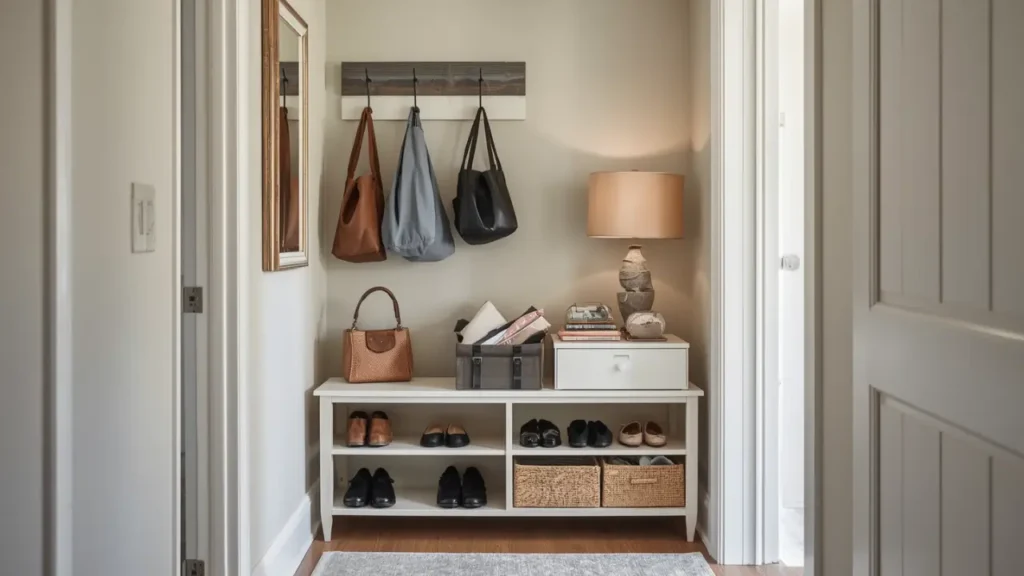
A Simple 30-Minute Entryway Reset
If your entryway feels messy today, you can make progress quickly.
Try this 30-minute reset:
First 5 minutes: Remove everything that does not belong in the entryway.
Next 5 minutes: Sort shoes, bags, mail, keys, and small items.
Next 10 minutes: Clean the floor, console, mirror, hooks, and rug.
Next 5 minutes: Decide what needs a better home.
Final 5 minutes: Add one simple improvement, such as a tray, basket, hook, or lamp.
You do not need to redesign the entire space at once.
Start by making the entryway easier to use today.
Then improve one layer at a time.
To Make Coming Home Feel Better
A small entryway is more than a place to drop keys.
It is the first breath of home.
When this space is cluttered, dark, or chaotic, the rest of the home can feel less peaceful. But when the entryway is organized, even in a simple way, it creates a better transition into daily life.
You do not need a grand foyer.
You need a place for shoes.
A place for keys.
A place for bags.
A little light.
A little beauty.
A system you can actually keep.
Small entryway ideas work best when they support real routines.
Start with what bothers you most. Shoes on the floor. Keys disappearing. Bags without a home. Poor lighting. A narrow hallway that feels forgotten.
Then choose one smart solution.
A small home can still feel graceful, welcoming, and organized.
Sometimes, the transformation begins right by the door.
Suggested Articles:

Gui Perine
Gui Perine is the creator of Your Life in Full Bloom, a lifestyle website for women who want to live with more intention, beauty, and freedom after 50.
Through thoughtful articles on home, travel, reinvention, and everyday choices, she explores what it means to build a fuller life in a new season — one that feels calmer, more personal, and more aligned with who you are becoming.
Her work is inspired by real-life transitions, the desire for independence, and the belief that life after 50 can be a time of clarity, possibility, and renewal.

1 thought on “Small Entryway Ideas: 10 Clever Storage Tips”