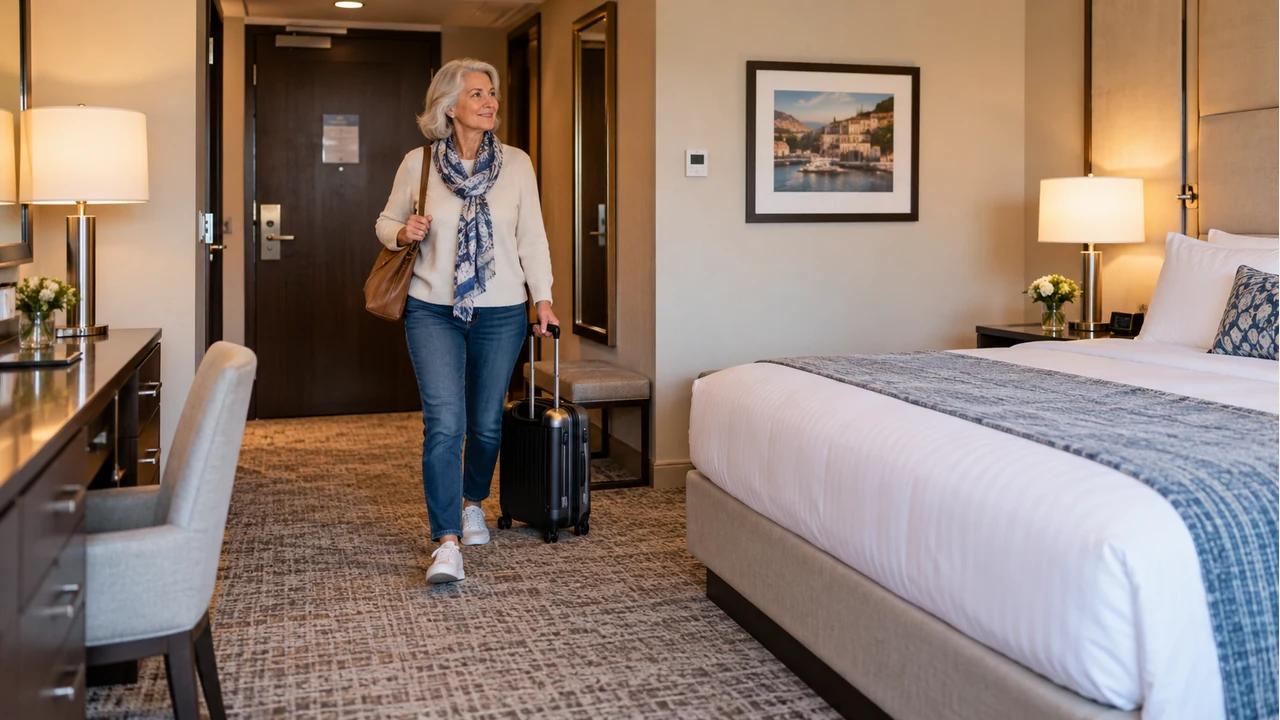
Hotel room accessibility depends on the match between a room and the person using it. A property can advertise an accessible room yet leave you uncertain about the doorway, shower, bed, lighting, or route from reception. The label starts the conversation; it does not answer all the questions that determine whether a stay will work.
You may use a mobility aid, travel with someone who does, need to avoid stairs, or have hearing, vision, or sensory requirements. You may simply find that a low bed or a shower over a bathtub makes travel harder than it needs to be. These are practical booking considerations, not reasons to settle for vague assurances.
Use this guide to turn your requirements into specific questions, compare the answers, and confirm the room you intend to reserve. The approach works internationally, while legal standards and booking protections vary by country. Where US rules are discussed, they are identified as US rules rather than promises about every hotel worldwide.
1. What does hotel room accessibility need to mean for you?
Start with the tasks you need to perform comfortably and safely: entering the building, reaching the room, moving around the bed, using the bathroom, receiving an alert, or sleeping without disruptive noise. A functional list is more useful than asking whether the hotel is “suitable for older guests.” Age alone does not describe your requirements.
Separate essentials from preferences. An essential feature determines whether you can use the accommodation; a preference improves the experience but may allow compromise. If you travel with a mobility device, use its actual dimensions and your own space requirements. Seek appropriate professional guidance where necessary rather than relying on a universal measurement from a travel article.
| Requirement | Essential or preferred? | Evidence to request | Booking decision |
|---|---|---|---|
| Step-free route to the room | Essential if you cannot use steps | Description of the complete route | Do not accept an unexplained gap |
| Bathroom arrangement | Depends on your needs | Current photos and relevant measurements | Confirm the exact room type |
| Bed access on a particular side | May be essential | Clear floor space and furniture layout | Check that the layout is available |
| Visual or audible alerts | Depends on your needs | Specific installed features and procedures | Confirm availability for your stay |
| Quiet location | Often a preference, sometimes essential | Room location and nearby noise sources | Assess the limits of any assurance |
Keep the list short enough for a hotel employee to answer accurately. You do not need to send medical records to explain that you require a step-free shower or a visual alert. Describe the feature and task, not private details that are unnecessary for the booking.
2. Is the whole route step-free, or only the bedroom?
Ask about the journey from your arrival point to the actual room. Hotel room accessibility can fail before the door if the entrance has steps, the accessible entrance is locked at night, or a lift does not reach the relevant floor. Include reception, corridors, and any separate buildings in the question.
If you arrive by car, ask about the route from parking or drop-off, not only whether parking is available. If you arrive on foot or by taxi, ask where the usable entrance is and how it operates outside reception hours. A sloping route, heavy door, uneven surface, or long distance may matter even when there are no steps.
Ask whether an alternative route depends on staff assistance and whether that assistance is available when you will arrive. A promise that “someone can help” needs practical detail. If a lift is essential, ask about the relevant lift and the property's procedure if it becomes unavailable. Do not assume a general statement about elevators covers your particular route.
For independent background information in Britain, VisitBritain’s accessible travel resources can point you toward specialist guides and planning tools. Use these alongside current information from the property, especially when your requirements are specific.

3. What is the usable doorway clearance?
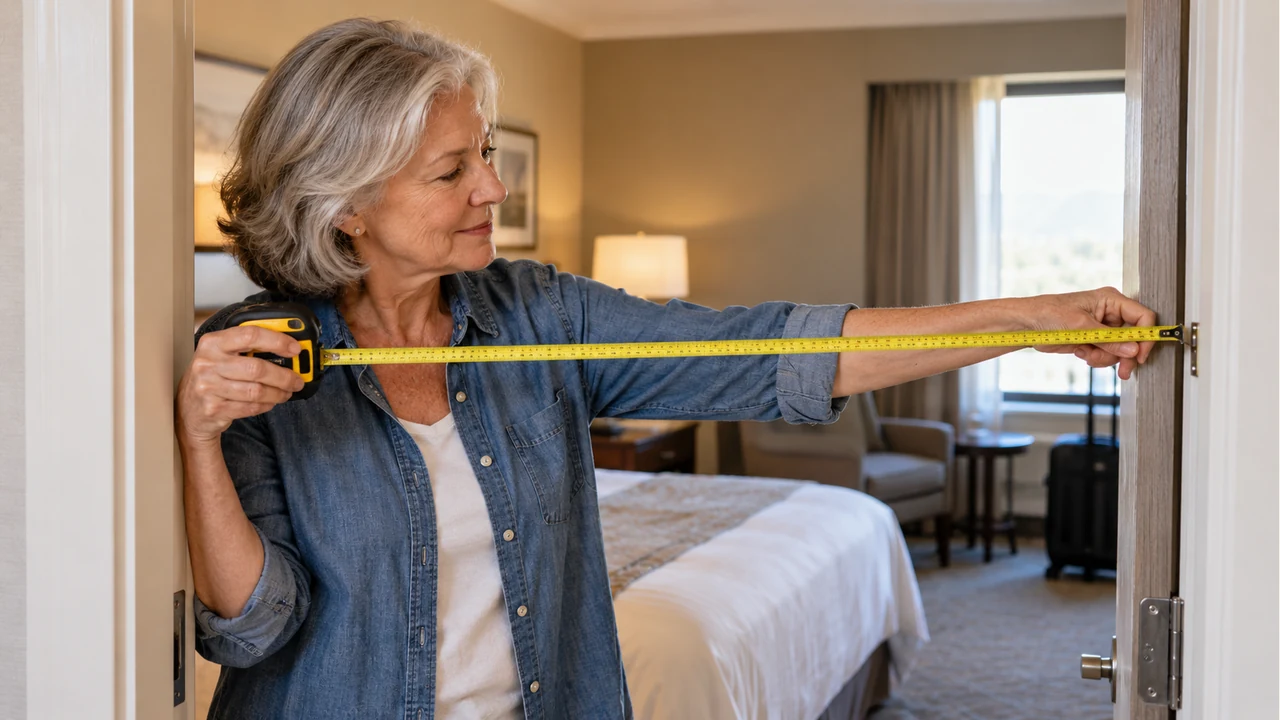
A door's advertised width may not describe the space actually available when it is open. Ask staff to explain what they have measured and where. If clearance matters for your device, request the usable opening at the relevant doorway rather than accepting a general assurance that a wheelchair can fit.
Check the bedroom entrance, bathroom door, and any narrower point along the route. Ask about thresholds and door operation as well as width. A sliding door, heavy closer, or restricted opening can affect usability differently. Use consistent units when comparing information, and have unclear answers clarified rather than converting an uncertain number into apparent precision.
A photograph can help show the arrangement, but it cannot reliably establish exact clearance on its own. Ask whether the photograph shows the room category you are booking and whether furniture or fittings have changed. Generic promotional images may show a different layout.
Hotel room accessibility should be assessed against your own requirements. Avoid deciding that a room will work simply because a previous reviewer used a similar device. Their dimensions, methods of moving, and level of assistance may differ from yours.
4. Can you approach and use the bed as required?
Ask about bed height, the space beside it, and which side is accessible. A room with a generous central floor area may still have one side of the bed against a wall. Twin beds, connecting rooms, and different bed sizes can also change the available space.
Explain the task: “I need clear access along the left side when facing the headboard.” This is less ambiguous than “I need space on my side.” If under-bed clearance matters for equipment you use, ask about that separately and confirm that the room can accommodate the equipment. Do not assume every accessible room has the same bed base.
Check whether the quoted bed height includes the mattress and whether the bed can actually be adjusted. A vague promise to make changes on arrival may be less useful than a confirmed existing arrangement. Do not plan to move heavy furniture yourself to make the room work.
For hotel room accessibility, a small layout detail can matter more than room size. Request a current photograph or simple layout explanation showing the bed, nearby furniture, and route to the bathroom. Confirm whether any agreed adjustment can be completed before arrival and recorded with the reservation.
5. What exactly is the shower and toilet arrangement?
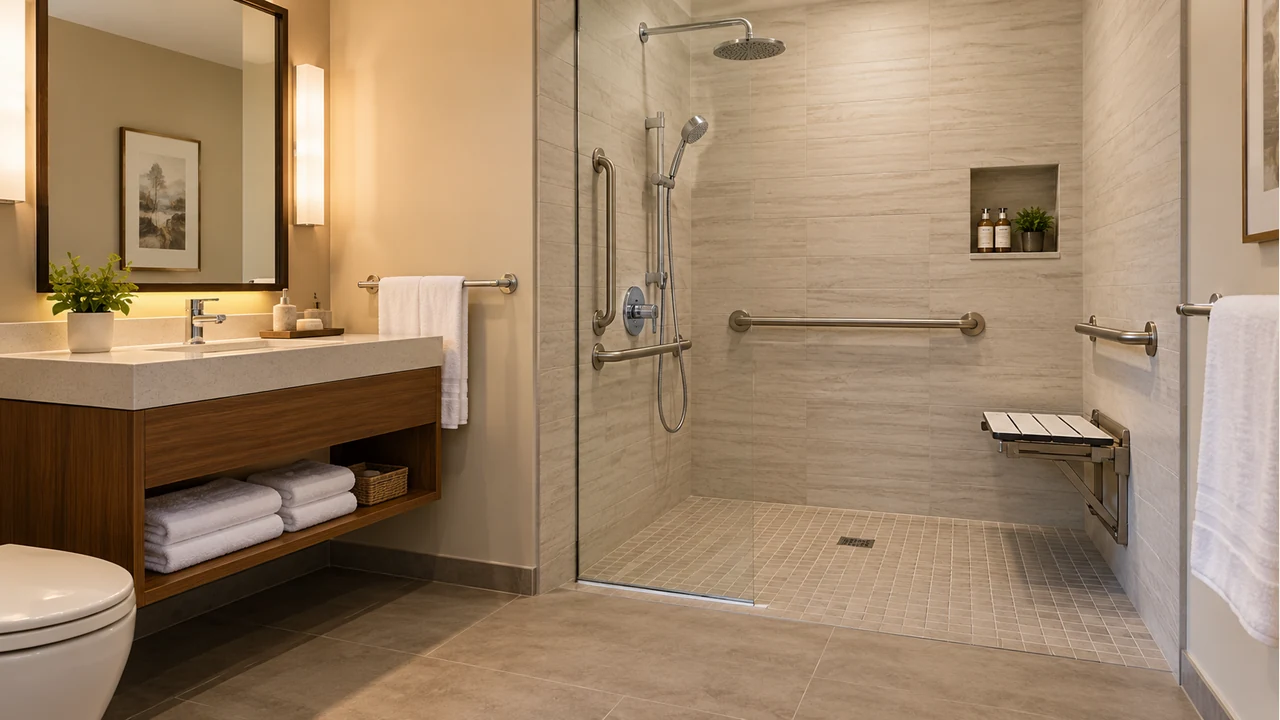
Bathroom descriptions are often too broad. “Accessible bathroom” may refer to different combinations of features. Ask whether the shower has a step or lip, whether the floor is level at entry, and whether there is a fixed or fold-down seat if you require one. A shower over a bathtub is a different arrangement.
Ask about the features you will actually use
Before discussing individual fittings, explain your essential tasks and the side from which you need access. This gives staff a clearer basis for answering and prevents a long list of irrelevant features. A bathroom can contain grab bars yet still have a layout that does not meet your particular needs.
Ask where the grab bars are positioned, whether the shower controls and handheld shower are reachable for your use, and how much clear space is available beside the toilet. Request relevant measurements rather than treating a photograph as a scale drawing. There is no single ideal arrangement for every traveler.
Do not assume that a loose shower chair is equivalent to a built-in seat, or that either will suit you. Ask the hotel to confirm the actual equipment, availability, and any restrictions. If equipment is supplied by a separate service, clarify who arranges delivery, collection, and access to the room.
Keep the discussion factual. You are checking hotel room accessibility for your stay, not diagnosing whether a photograph proves legal compliance. If an essential feature cannot be confirmed, treat it as unresolved instead of filling the gap with optimism.
6. Which hearing, vision, and sensory features are available?
Hotel room accessibility is not limited to mobility. Depending on your needs, ask about visual or audible alerts, door notifications, telephone arrangements, lighting controls, contrast, signage, or a quieter room location. Ask for the specific feature rather than a broad “special assistance” promise.
For lighting, find out whether controls are reachable and whether the route from bed to bathroom can be lit appropriately. If you need information in a particular format, ask how the property provides it. If a service depends on equipment being brought to the room, confirm its availability for your dates and how it is checked.
For sensory preferences, explain the issue in practical terms: a room away from a lift, a connecting door, a music venue, or an outdoor smoking area, for example. Hotels may not be able to guarantee silence or the behavior of other guests. Distinguish a confirmed room location from a guarantee the property cannot realistically make.
Ask about emergency alerts and the property's arrangements relevant to you. Do not assume that an ordinary passenger lift can be used during an emergency. Discuss the property's procedures and any individual planning needs directly with staff before relying on them.
7. Are essential hotel facilities reachable too?
A workable bedroom is only part of hotel room accessibility. If breakfast, parking, a restaurant, or another facility is important to your plans, ask about the complete route and the facility itself. A hotel may offer an accessible room while locating breakfast on a different level or in another building.
Choose what genuinely matters for your trip. You do not need a detailed assessment of a pool you will not use. If a facility is essential, ask whether temporary closures, building work, or seasonal arrangements affect it during your dates. Current information matters more than an undated description.
Consider how the location affects the rest of your day. An accessible hotel entrance does not establish that the nearest public transport stop or surrounding pavement will work for you. Research the journey separately rather than expecting the hotel room accessibility label to cover the neighborhood.
Our retirement travel budget guide can help you consider the full cost of a stay. Compare the room price with realistic transport and meal arrangements. A cheaper room may offer little value if essential daily journeys become impractical or unexpectedly expensive.
8. Are you reserving the room type or making a request?
Ask whether the booking confirms the specific accessible room category and essential features, or merely adds a note to a standard reservation. These are different situations. Make sure the room description on the confirmation matches what staff have told you, particularly when booking through an intermediary.
In the United States, US Department of Justice ADA regulations for lodging reservations include requirements for covered places of lodging to describe accessible features in sufficient detail and address reserving accessible rooms. These are US requirements with a defined scope, not an international guarantee or a substitute for checking your booking.
If you book through a platform, clarify who is confirming the room features and who will handle a problem. A message to a platform may not mean the property has confirmed the arrangement. Keep written replies and check that they refer to your dates and intended room category.
Do not assume that paying more, choosing a familiar brand, or selecting a premium room resolves hotel room accessibility. Compare the actual features and the certainty of the booking. If essential details remain ambiguous, consider a property that can answer clearly before you commit.
9. Can the hotel confirm the essentials in writing?
A short written summary helps both sides notice misunderstandings. After a useful phone conversation, send the essential points through the property's verified contact channel or the booking system. Ask staff to correct anything inaccurate. Keep the request focused so that a general “yes” does not conceal unanswered questions.
You can adapt this message without including private medical information:
I am considering a stay from [date] to [date] in [room category]. Before booking, please confirm the step-free route from [arrival point], the usable doorway clearance, the bed access on [side], and the bathroom features listed below. Please state which features are confirmed for this room category and which are requests only. Current photographs and relevant measurements would be helpful. Thank you.
Add only the details relevant to you. If the reply omits a requirement, follow up on that point rather than resending a longer checklist. Ask for clarification when staff use terms differently from you, such as “walk-in” for a shower with a raised threshold.
A written reply is useful evidence of the discussion, but it does not make every statement a guarantee. Read the reservation and cancellation terms, and resolve contradictions before paying a nonrefundable rate. Hotel room accessibility is easier to evaluate while you still have choices.
10. What will you check before travel and on arrival?
Before departure, reconfirm the essential arrangements through the hotel's established channel, especially if the booking was made well in advance. Ask whether anything has changed in the room, route, lift service, or equipment you rely on. Keep the relevant reply and booking details available in a form you can access while traveling.
On arrival, check the hotel room accessibility features essential to you before fully unpacking. If something differs, explain the specific mismatch and ask staff about a suitable solution. Do not accept an alternative solely because it is described as an upgrade; verify the features that matter to you.
Think about a fallback before the trip, without treating it as an expected failure. Know the property's contact details, your booking provider's support route, and any relevant cancellation or relocation terms. Do not assume reimbursement or a particular remedy without checking the applicable arrangement.
For hotel room accessibility, this final review closes the gap between research and real use. It also gives you better information for a future stay. Record the room category and useful details privately, while remembering that layouts and services can change.
Questions worth asking before you commit
A precise question often does more than a longer search for the perfect label. These answers address common uncertainties that remain after the room features have been discussed. Keep legal requirements, individual usability, and booking conditions separate so that an answer to one does not appear to settle all three.
Does “accessible” mean the same thing everywhere?
No. Legal standards, terminology, building characteristics, and room features vary. Even rooms within one property may differ. Use the label to identify a potential option, then verify the features required for your stay. Do not assume that a familiar term carries identical meaning in another country.
Should I ask for photographs or measurements?
Ask for both when they answer different questions. A current photograph helps explain layout; a clearly described measurement helps assess clearance or reach. Neither is useful if it belongs to a different room category. Confirm what the information represents and use consistent units.
Can I choose an accessible room without using a wheelchair?
Mobility devices are only one reason someone may need particular room features. Explain your functional requirements and book the category that meets them, following the property's reservation process. Avoid assuming that a person's needs can be judged by appearance or that all accessible rooms serve identical purposes.
Before your next booking, write down three essential requirements for hotel room accessibility and ask a shortlisted property to confirm them. Clear answers will help you choose a room with more confidence than a reassuring label alone.

Gui Perine
Gui Perine is the creator of Your Life in Full Bloom, a lifestyle website for women who want to live with more intention, beauty, and freedom after 50.
Through thoughtful articles on home, travel, reinvention, and everyday choices, she explores what it means to build a fuller life in a new season — one that feels calmer, more personal, and more aligned with who you are becoming.
Her work is inspired by real-life transitions, the desire for independence, and the belief that life after 50 can be a time of clarity, possibility, and renewal.